Land deals lead the way in Dubai real estate market

Sector recording total sales worth Dh142.7 billion in Q1, the second highest quarterly figure on record

The first quarter of 2025 saw significant year-on-year increases in all Dubai real estate sectors.

Land deals emerged as a major factor in Dubai’s real estate market in the first quarter, recording a 193.8 per cent jump in plot sales worth Dh35.5 billion from 2,926 transactions.


Dubai’s real estate market has continued its buoyant start to 2025, recording total sales worth Dh142.7 billion in Q1, the second highest quarterly figure on record.

This represented a 30.3 per cent year-on-year leap in value, while the 45,485 overall sales transactions also meant a 22.8 per cent year-on-year increase.

A market update issued on Thursday by fäm Properties revealed that the Q1 results were only fractionally down on the all-time quarterly sales record of Dh147.2 billion from 50,218 transactions in Q4 2024.

Data from DXBinteract shows villa sales were up by 43.1 per cent year-on-year to Dh41.3 billion from 8,369 deals, while apartment sales rose by 12.6 per cent to Dh62.3 billion from 32,884 transactions. Commercial sales were also up by 25.2 per cent to Dh3.6 billion from 1,212 deals.


Rising property values in recent years were highlighted by a Q1 median price of Dh1,563 per sq ft, compared with the Q1 rates of Dh889 in 2021, Dh1,124 in 2022, Dh1,283 in 2023 and Dh1,497 last year.

The rise in land deals underscores the shrinking size of the availability of land in the emirate, experts say. “The reality is that plots for real estate development in Dubai are increasingly difficult to find, and this has led to land prices in the city soaring in recent years. Compared with COVID times, land prices have increased three or even four times in some areas, driven also by the exceptionally high demand we’re witnessing today in off-plan sales. Obviously, off-plan sales are carried out by real estate development companies, which cannot exist without land to develop. Hence, there is fierce competition among these developers to acquire land, making it a key factor in driving land prices higher,” said Firas Al Msaddi, CEO of fäm Properties.


“The only scenario in which we will see land prices falling or stabilizing would be if the off-plan real estate market starts to decline. Any slowdown in off-plan prices would have an immediate impact on land prices in Dubai,” he added.

Dubai’s Q1 property sales over the last five years have now risen to the current level from Dh21 billion (9,800 transactions) in 2020 to Dh24.6 billion (11,600) in 2021, Dh54.6 billion (20,200) in 2022, Dh89 billion (31,100) in 2023 and Dh109.5 billion (37,000) last year.


The top five performing areas of Dubai in terms of volume in Q1 were:


• Jumeirah Village Circle: 3,605 transactions valued at Dh4.559 billion


• Wadi Al Safa: 3,596 transactions valued Dh7.642 billion


• Business Bay: 2,782 transactions valued at Dh7.265 billion


• Dubai South: 2,676 transactions valued Dh8.745 billion


• Dubai Marina: 2,583 transactions valued at Dh9.284 billion

Firas Al Msaddi, CEO of fäm Properties

The most expensive individual property sold in Q1 was a luxury villa at Dubai Hills Estate which fetched Dh140 million. The most expensive apartment sold during the quarter went for Dh116 million at The Rings 1 at Jumeirah Second.


With properties worth Dh1-2 million accounting for 31 per cent of sales (14,242), 26 per cent (11,899) were below Dh1 million, 19 per cent (8,567) between Dh2-3 million, 15 per cent (6,837) between Dh3-5 million, and 9 per cent (3,939) more than Dh5 million.


Overall, first sales from developers significantly outnumbered re-sales in the secondary market – 65 per cent over 35 per cent in terms of volume and 61 per cent against 39 per cent in value.

“Once again we’re seeing figures which emphatically underscore the remarkable resilience and strength of Dubai’s real estate market, as the consistent growth of recent years continues,” said Al Msaddi. “This sustained upward trend cements Dubai’s position as a prime real estate investment hub, drawing increasing interest from global investors alongside strong demand from local and regional buyers.”

Philly2dubairealtor,………………..

Re-Blogged via Khaleej Times
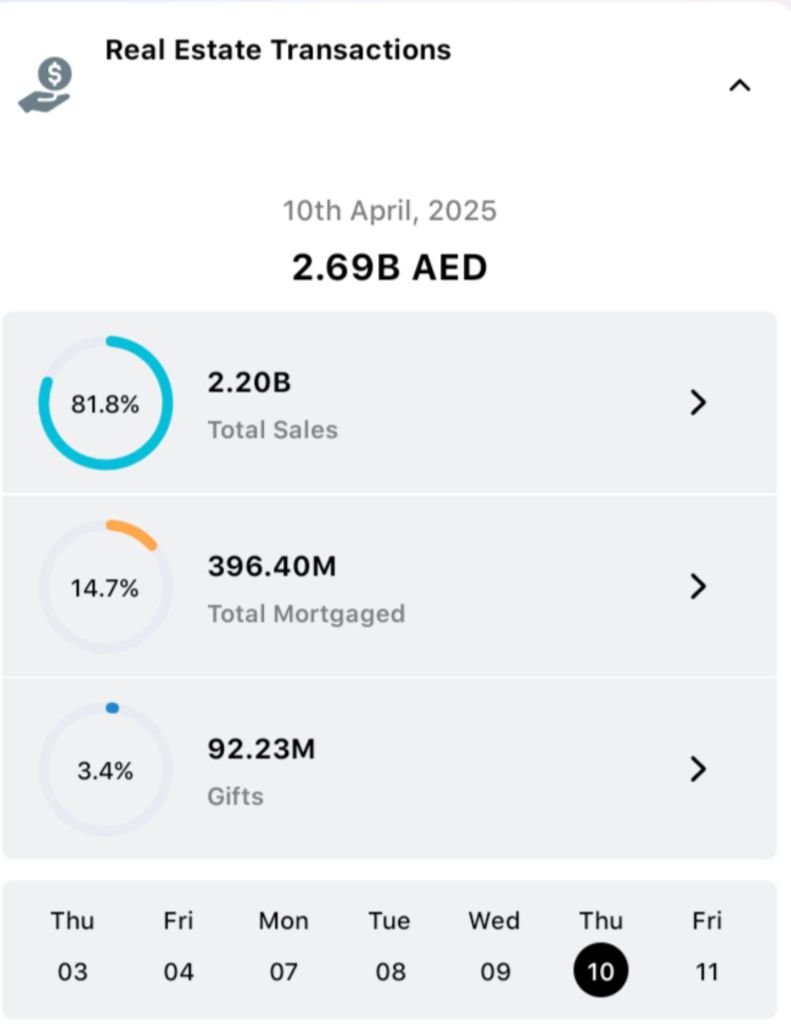
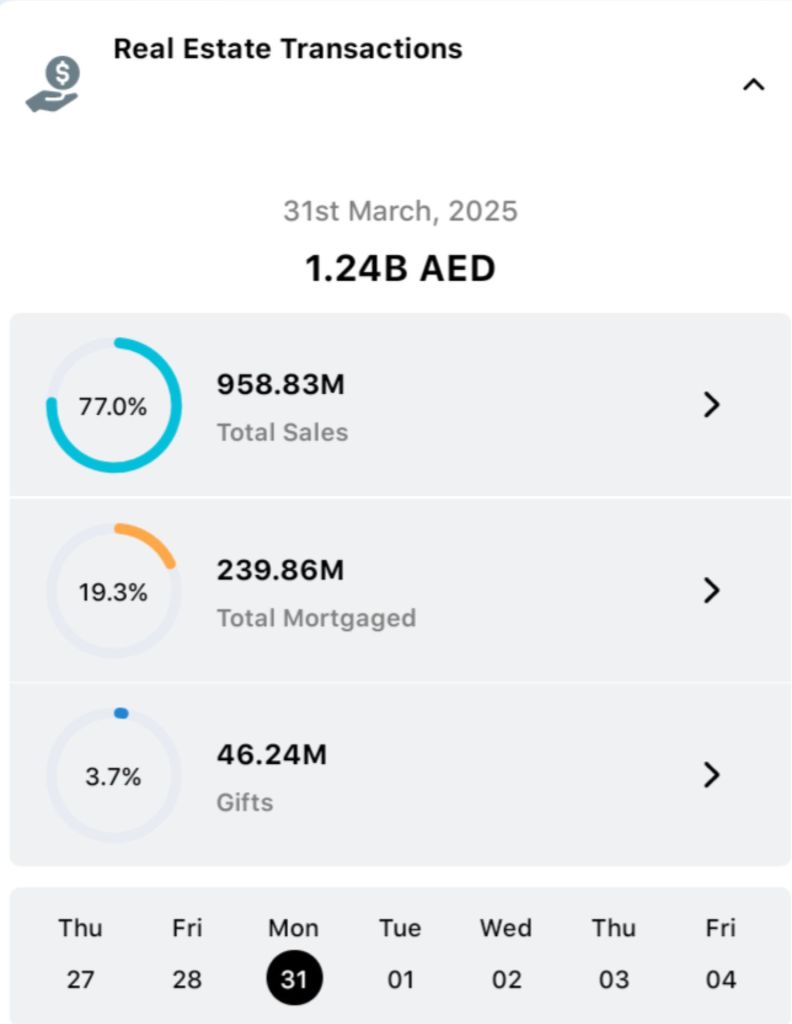
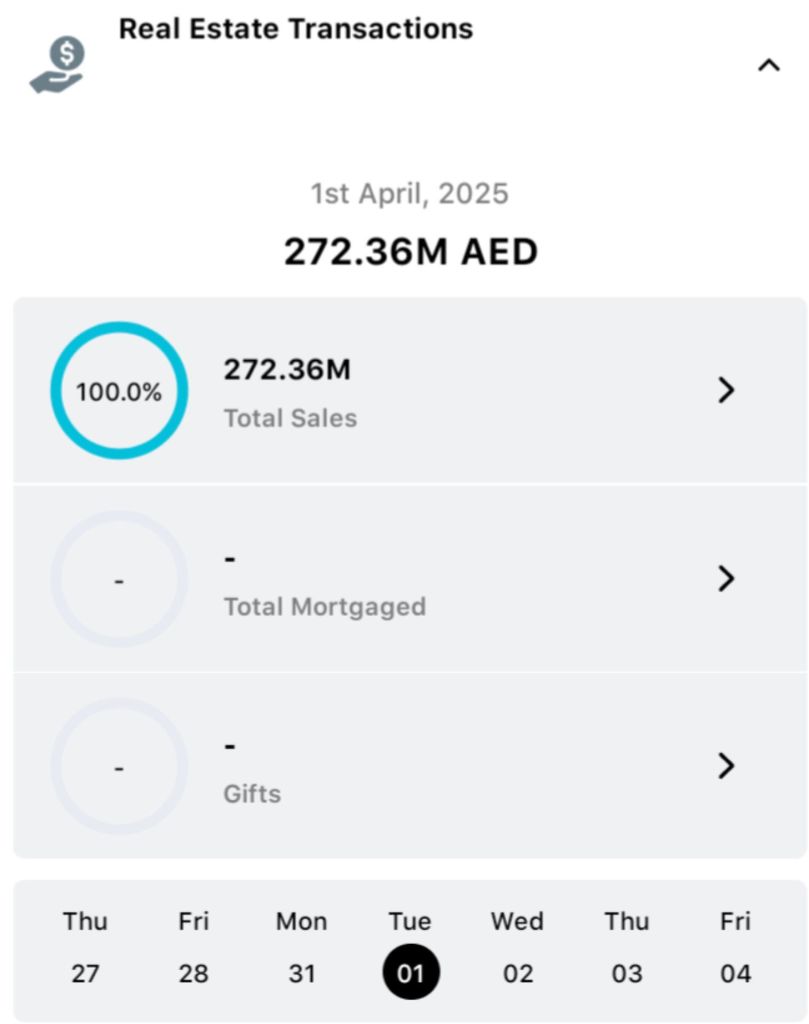
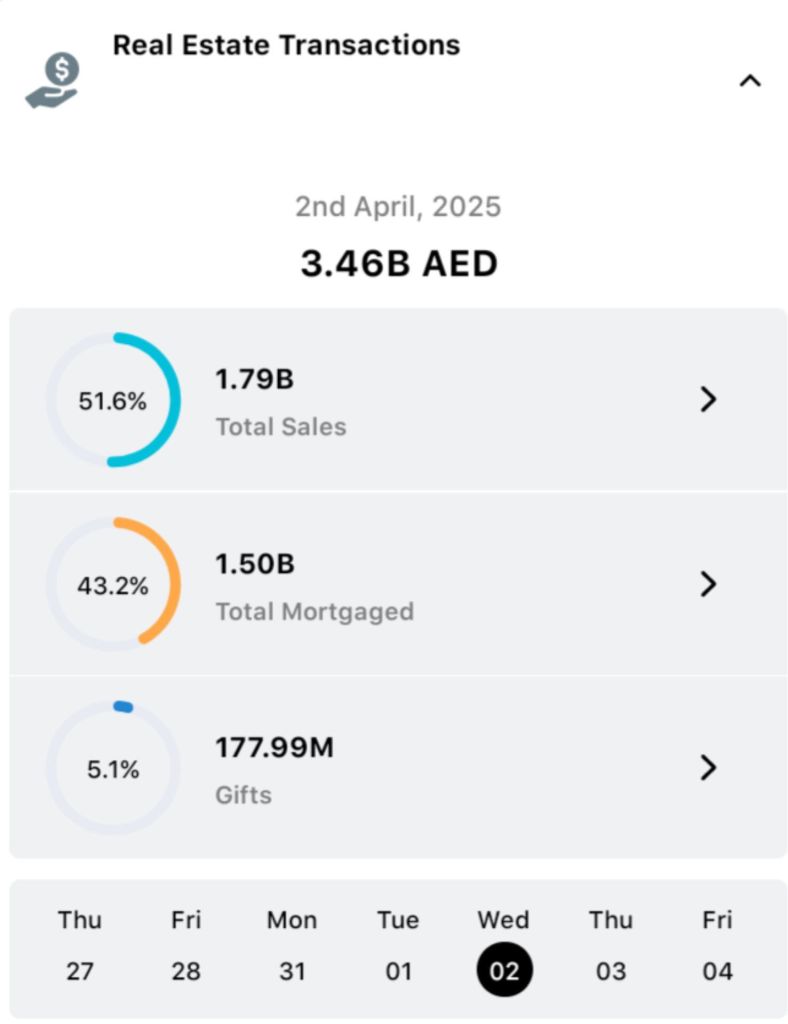
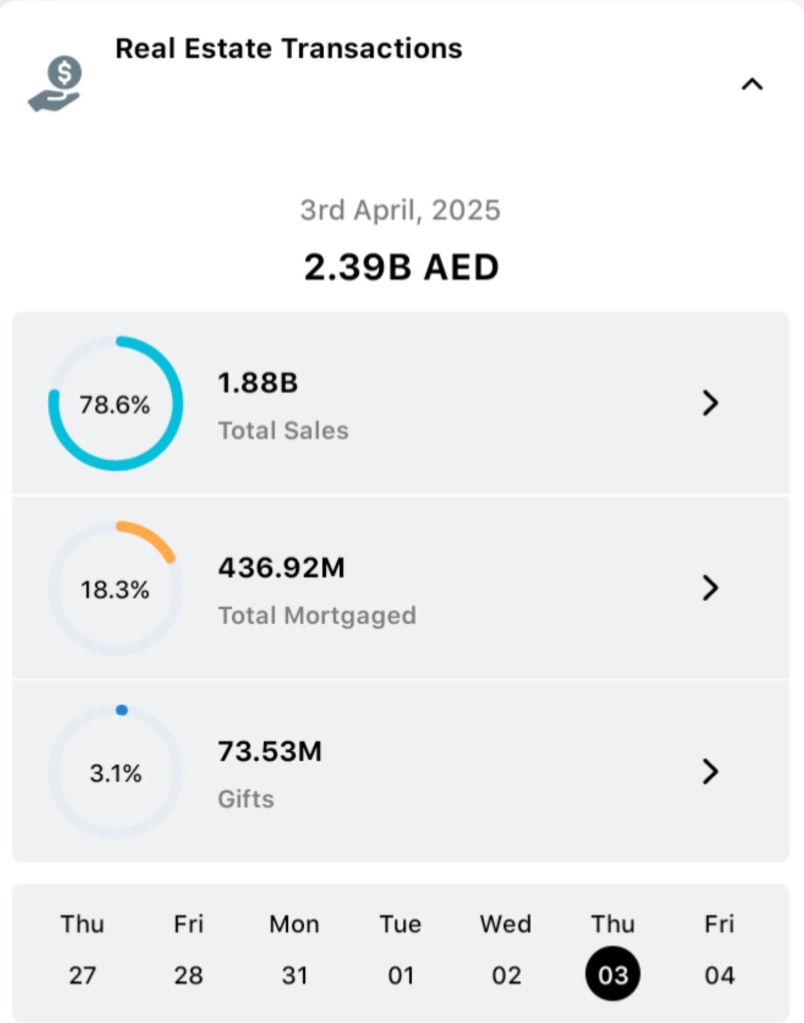
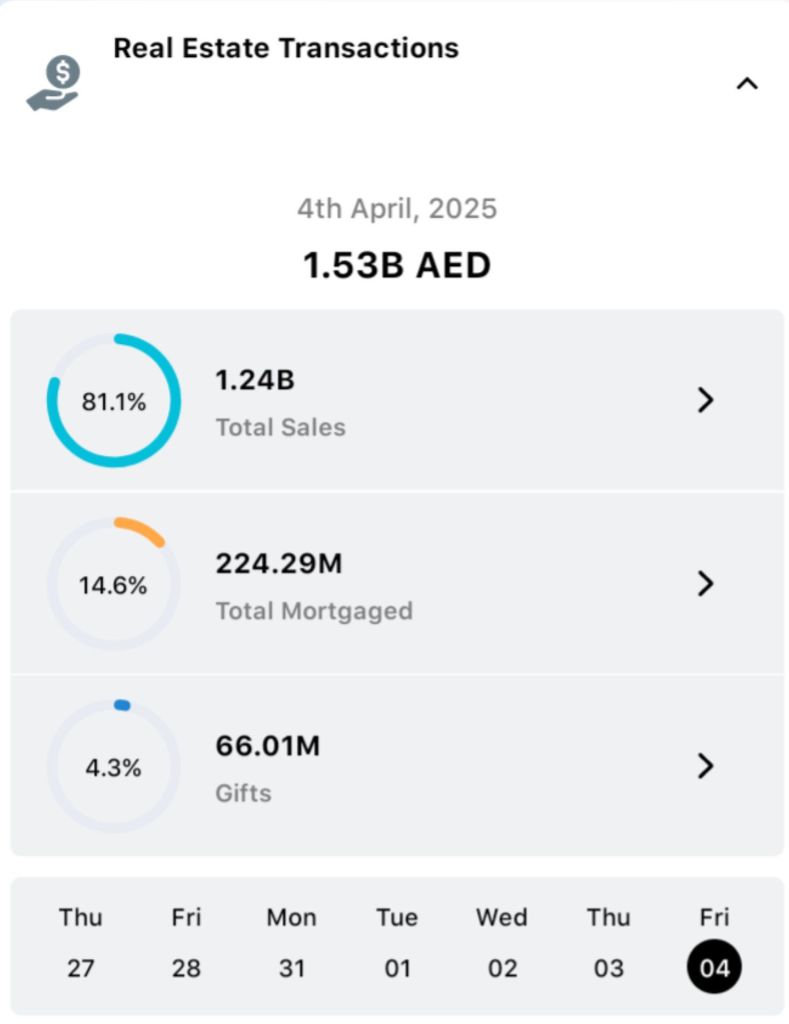
Dubai Real Estate Transactions For The Week Of March 31st 2025

Transactions reached a total of 1.8 Billion AED in the week of March 31st 2025 in both Offplan and secondary market sales

Monday

Tuesday

Wednesday

Thursday

Friday

If you are searching for residential properties to buy either offplan or ready Properties in the UAE, we will give you options to suit your budget.

Contact Us for more information , to book a unit or consultation session on WhatsApp +971 55 134 8912

Philly2dubairealtor………..

Are Dubai landlords rethinking short- vs. long rentals?

Dubai’s star-rating system has landlords explore what’s best for them

The kind of rental growth that Dubai’s short-stay rentals used to have has stabilized. This is the other factor landlords need to decide on when they choose between long-term rental and short.

Dubai: Another factor – the star rating system – has started to show up in Dubai landlords wanting to choose between renting out for a year or preferring to go for short-stay letting.

According to market sources, there has been a slowing down in the number of new homes coming for short-term rentals since the start of the year. Dubai’s new digital Rental Index and the star rating system that’s part of it is being cited by some landlords in choosing the 1-year annual rental option.

“Three of the landlords I represent decided to withdraw from short lets and put all their properties for long lease,” said an estate agent. “Together, these three landlords placed around 30-40 units for one-year leases, and got tenants immediately at higher than market averages.

“Buildings with high star ratings are able to command much more in the current market situation. Our clients felt this was too good to miss out on.”

Star rating adds a new factor

Under Dubai’s new Rental Index, a star rating assigned to each building should dictate what landlords can ask for – and on existing leases, sets ranges on how much more they can demand. What this has done is create fresh possibilities for landlords in the longer term rental.

It is also a conversation that more landlords with properties in Dubai are having, and with more when new apartments are delivered in the coming weeks. It’s more or less a given that newer buildings will have a higher rating – giving their landlords the latitude to ask for a higher rents.

At the same time, there are real estate sources say who believe that rental growth in the short-stay market has actually started to plateau out. They point to the sheer number of new units that entered the market during 2024, which also coincided with short-stay rental growth slowing down after two fairly brisk years.

The relative slowing down has extended into this year, which leaves landlords with less wiggle room to ask and get rates they demand.

Vinayak Mahtaini is CEO of bnbme, a business that specializes in shirt-term rentals and management.

“I don’t believe the number (of short-term rental properties) has declined – but the growth it used to have has slowed down,” said Mahtani.

“There are over 40,000 apartments now in the short-term market in Dubai. There is still value in these rentals for property owners. I think we will see a slight correction in the market where companies not adding extra value for the guest or property owner will start to fade away…

“I don’t think a property owner should only be looking at rental income when they think of what to do with the property.  Long-term rents have many hidden costs such as refurbishment when the tenant leaves, which also means the apartment will be off the market for weeks.

“Asset preservation is what owners should be looking at along with the peace of mind that they are in possession of their property.”

Dubai short-stay rentals are seeing gains for this week’s Eid holidays, with the popular locations seeing optimum take up rates, say industry sources. This upbeat demand will continue through to peak summer before slowing down.

It would leave landlords with enough time to choose between long or short rentals

Anna Skigin, CEO of Frank Porter, says that landlords choosing short lets have another advantage – “It is also about the flexibility of using the unit – or selling the unit when you want without having to deal with a tenant. There are more considerations to look at when looking at short-term versus long than one annual rent.”

Now, which way will Dubai landlords with new properties being handed over decide to go?

Will Dubai short-stay rentals get a rate boost?

Dubai’s short-stay rental market is hoping that rates would soon start to show a bit of a growth spurt after a relatively slow start so far in 2025. “This year’s Eid booking has been slightly soft with it coinciding with school holidays,” said Vinayak Mahtani of bnbme. “The staycation market is missing seeing rates between $100-$250 a night, which are about 30% down from last year.” This will also be something that landlords will be giving close watch to.

Tabreed JV to do district cooling at Palm Jebel Ali

In one of the biggest wins in the UAE district cooling space, Tabreed has won the agreement to offer these services at the prestigious Palm Jebel Ali development. Construction of the district cooling network on the island is likely to start in Q2-2025, with the first cooling services expected to be delivered by 2027. Over time, the system will address the need for approximately 250,000 RTs of cooling capacity and require an estimated investment of Dh1.5 billion. The project will be overseen by a joint venture, with Tabreed’s stake at 51% and Dubai Holding Investments with 49%.

Philly2dubairealtor,………………..

Re-Blogged via Gulf News

Dubai’s most expensive branded residences reach record prices, set new market standards

The emirate has outpaced traditional luxury real estate markets in terms of price appreciation, investor interest, and the volume of projects

Branded residences in Dubai command a 42 per cent premium, on average, over non-branded properties as institutional investors are also snapping up these luxury properties.

“Dubai’s real estate market is undergoing a fundamental shift. Branded residences are no longer a niche segment — they have become a core asset class, attracting institutional investors and setting new price benchmarks,” said Elias Hannoush, CEO of Morgan’s International Realty.

The luxury real estate brokerage and property investment firm’s data showed that branded residence prices averaged Dh3,288 per sqft compared to Dh2,321 per sqft for the non-branded units in Dubai at the end of 2024.

At the top of the market is Bvlgari, located on Jumeirah Bay Island, with the highest price per sqft at Dh10,668. Other luxury developments follow closely behind, including Atlantis Resorts (Dh9,387), Dorchester Collection (Dh7,539), Baccarat (Dh7,211), and Four Seasons Hotels and Resorts (Dh6,829).


Armani (Dh5,736), One & Only Resorts (Dh5,155), Six Senses Hotels & Resorts (Dh4,879), Bugatti (Dh4,682) and The Ritz-Carlton Hotel (Dh4,342) rounded off the top 10 properties.

Hannoush pointed out that Dubai has outpaced traditional luxury real estate markets in terms of price appreciation, investor interest, and the volume of projects.


According to Savills, Dubai retains its place as the most active market internationally for branded residences; it is followed by hotspots in Miami, New York, Phuket and London.


Sales of branded units in Dubai surged 48 per cent in the second half of 2024, reaching 7,628 compared to 5,153 in the same period in 2023.


Dubai currently boasts 132 branded residences with 43,085 units, including one that sold for a record Dh275 million. The highest price for the branded residence reached Dh17,235 per sqft.


Additionally, Dubai has 1,282 ready-branded units valued at Dh6.88 billion, with 6,346 more currently under construction, worth Dh24.9 billion.

“Pro-investor policies, world-class infrastructure, and a thriving luxury real estate market have fuelled Dubai’s growth into the global hub for branded residences.


“A tax-free economy, long-term residency incentives, and rising demand from international investors have driven rapid expansion, surpassing traditional luxury hubs and solidifying Dubai’s position as the premier destination for branded residences,” he added.


Hannoush noted that branded residences create a winning formula for all stakeholders. For developers, they offer higher prices, faster sell-outs, access to elite buyers, and enhanced credibility with global appeal.


For buyers, they provide superior design, exceptional service and management, stronger capital appreciation, better rental returns, and an exclusive lifestyle with hassle-free ownership. For brands, these properties bring new revenue opportunities and market expansion.

Philly2dubairealtor,……………..

Re-Blogged via Khaleej Times
Comparing Dubai’s property market with global cities is ‘night and day’, say experts

We take a look at how the emirate’s surging market matches up to other cities worldwide

It’s no secret that the property market in Dubai is in good health, with soaring house prices and rising rents showing no sign of abatement. But how does it compare to other parts of the world?

Dh1 million ($270,000) can buy you a two-bedroom apartment with private pool, gym access and a parking space in Dubai – but what can it get you elsewhere?


While many residents might long for property prices of years gone by, experts told The National that Dubai still offers significant value for money, particularly when compared to some of the more established global markets.

“In Dubai, you can get a nice one-bedroom apartment [for Dh1 million] or, if you go further out, you can get a two-bedroom in buildings with swimming pool access and parking spaces,” said Ben Blackwell, area manager at estate agency Betterhomes. “You’d just about get a parking space in London for the same money. Or else you’d have to be living way out on the outskirts to afford something similar for that price.”

The National reported last month how property prices were only going to increase, because demand was still exceeding supply, a report from ValuStrat management consultancy found. The same report said property prices for villas had increased by more than 31 per cent in 2024, while the price of apartments had increased by almost 24 per cent during the same period.

Cost of property around the world

Point size representing dirhams per square foot

Contrasting fortunes

Setting Dubai against other more-established property markets is hardly a like-for-like comparison, however, said another expert.

“You can’t directly compare them, each offers different things and the property market in Dubai has been operating for around 23 years, while it has been around for hundreds of years in London,” said Mario Volpi, head of brokerage at Novvi Properties. “What you can say is as an emerging market you get much more bang for your buck [in Dubai]. It’s very, very good value for money, despite three to four years of house prices inflating.”

It is clear that properties in Dubai are not getting cheaper but it still has some way to go to match the prices of some other established markets. The average cost of property in the emirate is Dh1,608.64 per sq ft, the Global Property Guide website suggests.

This is some way off the cost in Hong Kong, which is Dh8,046.88, while those living in Paris can expect to pay Dh3,527.43 and in London Dh3,447.62. If you are in New York, it is Dh1,862.06 and in Tokyo Dh1,718.82.

Mr Blackwell is adamant Dubai still offers value for money, especially compared to other markets across the world.

“It used to be the case, around 10 years ago, that the property market in Dubai might still have been seen as a gamble but that’s not the case any more,” he said. “Now it’s an established place, with more and more companies moving here and many international brands opting for Dubai as their headquarters. It’s a much more mature market and we’re seeing a change from it being completely investor based to end-user based. Although it is a lot more expensive than it was five to 10 years ago, comparably it still offers fantastic value and you can consider particularly the western markets.”

He said the difference between what you get in Dubai and in his hometown of London was clear. “It’s night and day what you get in London compared to Dubai,” said Mr Blackwell. “London is a massive commuter market where people are travelling from all over, which means people are having to go further and further out to get value for their money. To get something similar to the same price as what you would get in Dubai, you would have to be prepared for an extraordinarily long commute.”

Many other popular cities do have apartments on offer for about Dh1 million or less but they are likely to be smaller and/or less luxurious than those in Dubai for the same price.

In Hong Kong, this is enough for a 212 sq ft apartment in a tower block that many buyers would consider to be at the bottom end of  the market in terms of comfort.

Buyers in Tokyo could secure at 347 sq ft one-bedroom apartment in the Bunkyo-Ku neighbourhood a short commute north-west of the centre. It is in much better condition than an apartment for the same money in Hong Kong.

In New York, for about the same amount buyers have the option of a newly decorated 950 sq ft two-bedroom apartment in a gated community in the Bronx, a borough sometimes regarded as one of the city’s less safe areas. For about a fifth of the size, someone with Dh1 million in their pocket seeking a home in Paris could choose a compact 205 sq ft eighth-floor one-bedroom apartment in the 15th arrondissement.

Quality concerns

Mr Blackwell was also quick to dispel suggestions that properties in the region were inferior in terms of durability compared to more mature markets. “The reason why people feel buildings age quicker here is because there are so many new buildings being constructed, so anything that’s even just five years old might suddenly feel old,” he said. “The truth is you have some fantastic construction companies here [in Dubai] that are delivering high-quality products.”

Investors told The National last month that the property market in Dubai was “on steroids”. The emirate’s real estate sector has maintained robust growth momentum in recent years, recording deals worth Dh761 billion ($207.2 billion) last year, up 20 per cent annually. The boom is aided by government initiatives including residency permits for retired and remote workers, an expanded golden visa programme, as well as strong economic growth in the UAE.

Global buyers

It is not only London that Dubai measures well against. “Dubai offers great value compared to cities like London, Tokyo and New York for a few key reasons,” said Lewis Allsopp, chairman at Allsopp & Allsopp estate agency. “Being a relatively new city, Dubai was planned for efficiency and has benefitted from modern urban infrastructure, well-organised communities and highly desirable living spaces.”

Another factor in Dubai’s desirability was the likelihood of making a profit on your investment, he added. “As an investment, your property in Dubai is more likely to increase in value than the UK due to the buoyant market in the UAE,” said Mr Allsopp. “Dubai’s business-friendly environment with minimal taxation and no property taxes makes it a highly cost-effective choice for homeowners and businesses alike. Simply put, you get for your money in Dubai.”

According to Kelcie Sellers, an associate director at the property agent Savills and a member of the company’s World Research Consultancy, “Dubai represents incredible value” compared to cities such as San Francisco, London, Paris, Hong Kong and Tokyo.

She said the emirate’s prices provided better value because the city was “much less space-constrained” and had “a lot more room for growth” than, for example, Hong Kong, New York or Tokyo. According to Savills’ data, prices per square foot in Hong Kong are about four times those of Dubai, while central London is more than twice as expensive, Tokyo is nearly 130 per cent more costly and Paris twice as much.

The company reported that average capital values in Dubai increased 6.8 per cent last year. Only a handful of major world cities – Madrid, Barcelona, Tokyo, Amsterdam and Seoul – recorded percentage increases as high as those in Dubai.

“We’ve been seeing constantly elevated capital value growth in Dubai over the past couple of years, even though there’s room for growth, and we’re seeing supply being added relatively frequently,” Ms Sellers said. “What we’re seeing when we speak to our teams out there is there’s an incredible amount of demand for residential property out there.

“When we’re talking about Dubai, we’re seeing very global buyers. There are buyers from across Europe, North America, Asia-Pac [Asia-Pacific]. It’s seen as this destination that’s been on everyone’s list for the last couple of years.”

In Savills’ World Cities Prime Residential report there are only a few major cities – Barcelona, Cape Town and Kuala Lumpur – where properties are cheaper than in Dubai. Of these, Barcelona is only about 6 per cent cheaper than Dubai, Ms Sellers said, while Cape Town and Kuala Lumpur may be more regional markets but are nevertheless “growing quickly”.

Philly2dubairealtor,………………

Re-Blogged via The National

More investors turn to fractional ownership to enter booming Dubai property market

Format lowers individual financial burden and provides more people access to high-value assets

UAE resident Tim Prins, 28, from the Netherlands, signed up with fractional property investment platform Stake two years ago and invested €113 (Dh500 then) in a property.

Fractional ownership is a method in which several unrelated parties can share in, and reduce the risk of, ownership of a high-value tangible asset, usually such as real estate, a jet or yacht.


UAE Edition
Podcasts
Newsletters
Follow us
Video
Ramadan
Weekend
News


Business


Opinion


Future


Climate


Health
Culture


Lifestyle


Sport


Carrying out fractional property investment through a formal company structure generally offers more legal protection. Getty Images

Business

Money

More investors turn to fractional ownership to enter booming Dubai property market
Format lowers individual financial burden and provides more people access to high-value assets
Deepthi Nair
Deepthi Nair
April 01, 2025

UAE resident Tim Prins, 28, from the Netherlands, signed up with fractional property investment platform Stake two years ago and invested €113 (Dh500 then) in a property.

Fractional ownership is a method in which several unrelated parties can share in, and reduce the risk of, ownership of a high-value tangible asset, usually such as real estate, a jet or yacht.


When he started receiving rent income and noticed the property’s value was rising, Mr Prins increased the investment amount and spread it out over several units. He now has more than Dh100,000 ($27,229) invested across different properties and earns about 5 per cent to 6 per cent of the amount invested annually in rental yields. This is equal to about Dh500 in rental income per month that is transferred to his account.

The properties he has investments in are located in communities such as Jumeirah Village Circle, Mohammed bn Rashid City, Dubai Marina and Palm Jumeirah.

“I don’t have enough money to buy a property outright. With Dh100,000, I would not be able to buy a property without taking a bank loan,” says Mr Prins, who works with a start-up.

“I can now invest in multiple properties at the same time, and the company manages it, so I don’t have to make a decision. If I buy something myself, I might not know what to choose. The process has been transparent and hassle-free.”

Steps involved

Fractional ownership is emerging as an alternative entry point into Dubai’s real estate market, particularly for investors seeking access to premium properties without the burden of full capital exposure. It also enables diversification across locations or asset types, and in many cases, lowers the ongoing operational burden per investor.

Typically, this model is structured through a special purpose vehicle (SPV), where the SPV holds the legal title to the property and issues shares to investors proportionate to their contribution. While individual names do not appear on the title deed, the SPV structure typically provides a transparent and governed framework for shared ownership, offering clarity around rights, responsibilities and exit strategies.

Mr Prin said Stake offered to sell a few of his properties, but he declined because he believes values will rise more in Dubai, and he is a long-term investor. “I want my money to grow as much as possible,” he says. “You can sell your stake in a collective vote or during the exit window.”

However, he asks investors to be aware of exit fees, transaction charges such as the Dubai Land Department fee of 4 per cent and the property transfer fee, which are spread across all investors in the property.

Transaction costs are additional fees that are added to the purchase price of the property to complete the legal transfer of the asset from the seller to the buyer. These fees include the DLD transfer and registration fees, trustee fees, brokerage fees, property insurance, valuation fee and DIFC fees, according to the Stake website.


Rami Tabbara, co-founder of Stake, says fractional ownership makes buying property “more affordable” for people who do not have the amount for large downpayments or do not want to commit a lot of capital.

“It offers a much more transparent experience versus the open market and is digital, so you enable people to buy real estate on an app in under three minutes. It allows you to diversify and lower your risk,” he says.

“If you have $5,000 or $10,000, instead of placing all that capital into one property, you can put it across 20 properties.”

Rental yields

The minimum amount for investment in Stake currently is Dh500 and the rental income is paid monthly into the investor’s Stake wallet, which can be withdrawn to their bank account globally. The platform launched in 2021 and has more than a million users. Stake says it has transacted just under Dh1 billion across 400 apartments.

Stake’s portfolio today pays rental yields of about 5.7 per cent net annually, which is distributed every month, and offers capital appreciation of just over 5 per cent a year.

After a lock-in period of one year, the platform allows people to sell their stakes in two windows every six months. They can list their stakes on the secondary market to sell to other investors, according to Mr Tabbara.

“We’ve exited over 20 apartments when we received offers of higher prices. We send the vote to the investors on the app, and if the majority decide to sell, they can exit the property,” he says.

“Right now, we deal in ready apartments, villas and townhouses because there’s a limitation of up to $10 million per asset by the Dubai Financial Services Authority. We’re working with the DLD and the DIFC regulator to allow us to start selling off-plan. We hope the DLD’s tokenisation announcement will enable us to transact more asset classes outside residential and of higher value too.”

Stake charges a one-time acquisition fee of 1.5 per cent, a management fee of 0.5 per cent of the investment value taken from the rent annually, an exit fee of 2.5 per cent at the time of sale and a performance fee of 7 per cent on the appreciation profits, according to its website.

Riz Ahmed, chief executive of Dubai-based SmartCrowd, first interacted with the crowdfunding platform as a customer. He recalls that instead of putting $200,000 into one property, he spread it across 10 properties.

The company takes care of finding tenants, renewals, handling disputes, managing exits and documentation, while also offering investors the benefit of diversifying their assets, he says.

Democratising access

“The minimum you can invest from is Dh500. This is our way to democratise access to real estate. But we have people investing millions of dirhams and most of our investors are outside the UAE,” Mr Ahmed says.

The company has done 50 exits and funded more than 150 properties. It offers net returns of 17 per cent annually and the average hold period is three years. The platform charges a 1.5 per cent upfront free, 0.5 per cent a year management fee, and 2.5 per cent on exit, according to Mr Ahmed. It offers a “conservative” estimate of capital appreciation at 5 per cent to 6 per cent a year.

For every crowdfunding activity, SmartCrowd sets up an SPV that will own the property and investors own shares in it. This is done through the DFSA’s regulatory framework.

The platform opens a secondary window for two weeks every six months for users to sell their shares or buy someone else’s.

“Our plan for the future is to start offering off-plan properties. At the moment, we only do units on the secondary market,” the chief executive says.

Changing structures

But equity crowdfunding is expensive, says Scott Thiel, chief executive and co-founder of Tokinvest, a Dubai-based Vara-licensed marketplace for asset investing.

“You need to set up a DIFC crowdfunding structured vehicle for every single apartment. That is a fairly high cost, particularly when you’re talking about properties around the Dh1 million mark. It can cost a non-trivial amount of money to set up those companies, do share registrations and transfer shares,” he says.

“They are not liquid when it comes to selling the share since they are not publicly listed. Equity crowdfunding rules also restrict the amount that can be raised.”

Michael Kortbawi, partner at BSA Law, also highlights that the shared nature of the investment in fractional ownership means investors usually have limited control over decisions, especially when a management company or majority vote is involved.

“Selling a fractional share can also be challenging; liquidity is often lower than with traditional full ownership, and finding a buyer willing to purchase just a portion of a property may take time. Additionally, the resale value of a fractional share may not always match expectations, particularly if market conditions change or the structure lacks clear exit provisions,” Mr Kortbawi says.

“It’s also important to note that co-owners are bound by a right of first refusal, meaning they must first offer their share to existing investors before selling it to an external party. This pre-emptive right protects the current ownership structure but can delay exit plans.”

Due diligence remains key

Fractional ownership is still early in its adoption curve, but the concept is gaining traction, says Farooq Syed, chief executive of Springfield Property.

While a structured route, whether through an SPV or licensed fractional investment platform, offers transparency in ownership and enforceable agreements, there are complexities.

Liquidity remains limited, particularly where no secondary market exists for fractional shares. Investors may also have limited control over key decisions, depending on how the ownership is structured and managed. Transparency, especially around fees, timelines and exit options, can vary significantly between platforms, Mr Syed points out.

“Fractional ownership requires the same level of due diligence as any traditional real estate investment,” he says. “Key considerations, such as decision-making authority, distribution of returns, asset oversight and mechanisms for dispute resolution, should be explicitly defined and contractually secured prior to commitment.”

While informal arrangements, such as the pooling of funds among friends, may appear convenient, but they can quickly become complex when faced with differing expectations, personal circumstances or unforeseen market shifts, Mr Syed says.

Mr Kortbawi also stresses that engaging in fractional property investment through a formal company structure generally offers more legal protection and operational efficiency compared to informal arrangements.

Companies that offer fractional ownership services typically provide standardised contracts that clearly define each investor’s rights, responsibilities and exit options, which reduces the chance of future disputes, he explains.

On the other hand, informal arrangements can become legally complicated, Mr Kortbawi says. They may overlook important regulatory requirements set by the DLD or the Real Estate Regulatory Agency. Informal ownership without a proper SPV or co-ownership registration may even hinder the ability to enforce your ownership rights in court, he warns.

Impact of tokenisation initiative

Dubai’s recent tokenisation initiative will remove the need for SPV corporate structures to fractionally own real estate, according to Mr Thiel.

“The death of the SPV is going to be very significant, particularly for smaller investors and smaller properties, because the cost and inefficiency of having to set up those corporate structures are going to disappear,” he says.

“Another benefit is that the owner of these tokens will have their details recorded at the land registry. Also, tokenised assets can be used in collateral or alone. We’re very bullish on the future of tokenised assets being used to create instantaneous capital.”

Philly2dubairealtor,………………….

Re-Blogged via The National

The Dubai phenomenon

The emirate offers one of the world’s most dynamic real estate markets for investors

Masih Imtiaz, CEO, Imtiaz Developments

This article is not merely a reflection on Dubai’s success; it’s a celebration of a city that has come a long way from its humble beginnings. Under the visionary leadership of His Highness Shaikh Mohammad Bin Rashid Al Maktoum, Vice-President and Prime Minister of the UAE and Ruler of Dubai, the Emirate has transformed from a quiet desert port into one of the world’s most dynamic and vibrant cities. Shaikh Mohammad’s foresight and relentless pursuit of excellence have shaped Dubai into a beacon of possibility — a place where boundaries are constantly redefined, and aspirations are welcomed with open arms.

Dubai stands today as a powerful example of what can be achieved when ambition is paired with an unwavering commitment to progress. It’s a city where extraordinary achievements are the norm, and dreams aren’t just possible — they’re expected. This is a place where opportunity flourishes, where families from all over the world find a sense of belonging, and where the quality of life is among the finest anywhere.

Dubai embodies a unique fusion of modernity and tradition, offering not only a home but a vision that continues to inspire global admiration and ambition.

For investors, Dubai offers one of the most dynamic and promising real estate markets in the world. Through the cycles of real estate growth and recalibration, Dubai consistently proves itself resilient, presenting opportunities that are simply unmatched. As the CEO of Imtiaz Developments, I have witnessed first-hand the extraordinary returns and potential this market holds. It’s a market defined not by quick gains but by a steady, reliable trajectory that benefits all who contribute to its growth.

While markets everywhere experience shifts, Dubai’s real estate story is one of sustained resilience and boundless potential.

Yet, Dubai’s accomplishments are not measured by buildings alone. Here, quality of life is a priority. From world-class education to pioneering healthcare systems, Dubai is a city where families can put down roots and build lasting futures. Safety and security are woven into the fabric of life here, creating a sanctuary for residents and an ideal place for raising families.

This is a city that offers peace of mind as much as it offers opportunity — a balance that is rare and invaluable.

Dubai’s fundamentals have matured over the years, proving its resilience against global economic shifts and conditions. The city’s strategic planning, diversified economy, and robust infrastructure have enabled it to weather challenges that have impacted markets worldwide. This stability and maturity are a strong reflection of Dubai’s commitment to sustainable growth and long-term vision, providing a foundation that continues to attract investors, businesses, and residents seeking stability, security, and opportunity.

History has taught us one enduring lesson: never bet against Dubai. Time and again, this city has defied the odds, rising stronger with every challenge it faces. From humble beginnings, Dubai has consistently shown that vision prevails, overcoming every hurdle with an unshakable resolve. It’s a city that doesn’t just dream but dares to achieve, standing as a powerful symbol of the strength of belief and resilience. Dubai’s journey is a reminder that when ambition is guided by vision, no challenge is insurmountable.

Dubai’s government has taken a proactive approach to continuously enhance infrastructure and lifestyle facilities, keeping pace with its ambitious growth. Strategic projects — such as the expansion of transportation networks, advanced healthcare facilities, and state-of-the-art recreational and cultural centers — are all part of a vision to ensure that Dubai remains one of the most liveable cities globally. These initiatives not only improve daily life for residents but also elevate Dubai’s appeal as a destination for businesses, investors, and families from across the globe.

I am genuinely excited to see what Dubai will look like in the next five years, as these transformative projects come to fruition and the city welcomes a growing population that will bring even more vibrancy and dynamism to this remarkable place.

At the heart of Dubai’s story is its leadership, whose vision has guided every step of this extraordinary transformation. Their approach is not simply to keep up with the future but to shape it, making Dubai a place that defies limitations and embraces challenges. They have ensured that Dubai’s growth benefits everyone, creating an ecosystem where innovation, stability, and inclusivity coexist. The courage and foresight of Dubai’s leaders have made sure the city not only beats every prediction but also sets new global benchmarks, emerging stronger from every challenge.

At Imtiaz, we are honoured to be part of this legacy. We believe deeply in Dubai’s fundamentals, and it’s this belief that drives us every day as we build not just spaces, but experiences that mirror Dubai’s spirit of resilience and ambition. Our projects are part of a larger vision, a commitment to creating a future that upholds Dubai’s values and inspires the world.

The story of Dubai is one of belief — a belief in the improbable, in the resilience of human ambition, and in the possibilities of tomorrow. It’s a miracle that proves itself, time and time again. We at Imtiaz are proud to contribute to this miracle, building the next chapter of Dubai’s journey, and with each project, bringing a piece of that vision to life.

– By Masih Imtiaz, CEO, Imtiaz Developments

Philly2dubairealtor,…………………

Re-Blogged via Gulf News

Dubai Real Estate Transactions For The Week Of March 24th 2025

Transactions reached a total of 7.7 Billion AED in the week of March 24th 2025 in both Offplan and secondary market sales

Monday

Tuesday

Wednesday

Thursday

Friday

If you are searching for residential properties to buy either offplan or ready Properties in the UAE, we will give you options to suit your budget.

Contact Us for more information , to book a unit or consultation session on WhatsApp +971 55 134 8912

Philly2dubairealtor………..

How can we decode the relentless property boom in Dubai?

Experts say Dubai’s current cycle is underpinned by strong fundamentals

The UAE’s real estate sector has continued its record-breaking trajectory this year, as the property boom shows no signs of slowing down. Dubai has been leading the charge as more people flock to the emirate to work and live. KT Luxe spoke to some of the country’s leading property experts to get their views on what is fuelling the boom, how long they think it will last, and the latest buyer trends.


Let’s start by looking at what is causing this boom. In basic economics, when demand outstrips supply then prices will rise. Dubai is an attractive place to live with its tax-free status, business-friendly policies, good quality of life and a wide range of visas for entrepreneurs and start-ups.

Last year we saw approximately 160,000 people move to Dubai and by the end of 2024 the population stood at 3.8 million. So demand is high.

Property developers have been playing catch-up, trying to match this demand by building homes for new residents. And we can’t forget property investors, particularly from the UK and India, who see Dubai as an attractive location for rental income and capital growth.

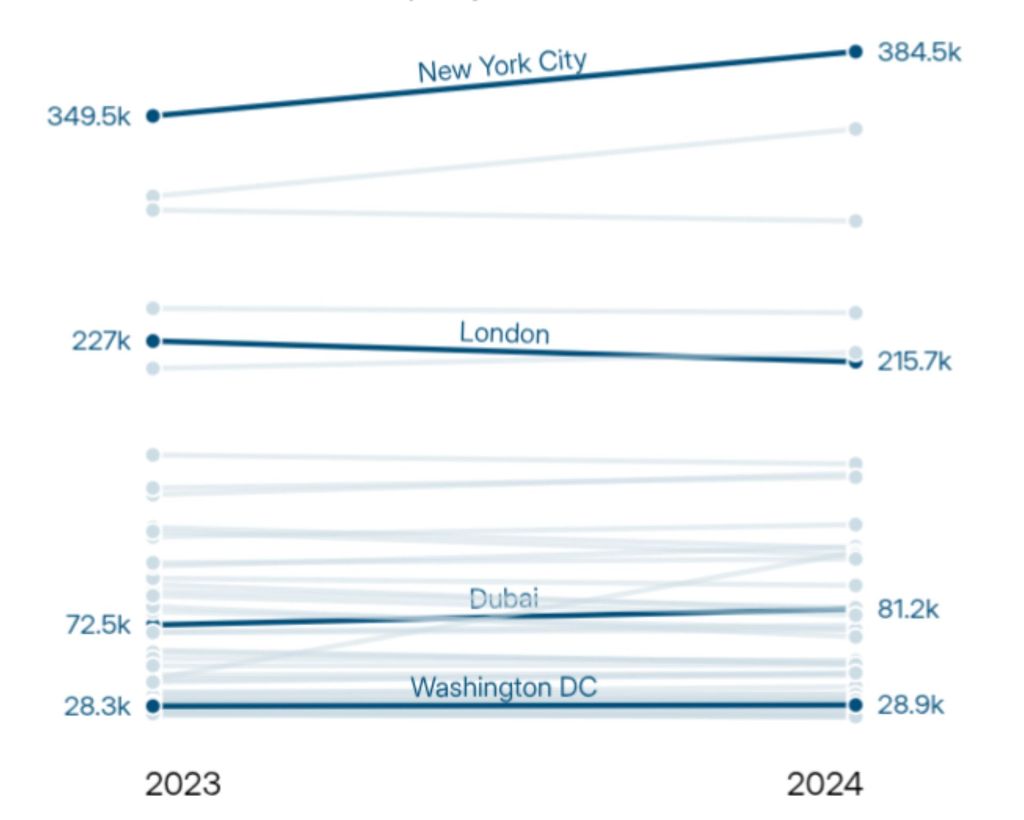
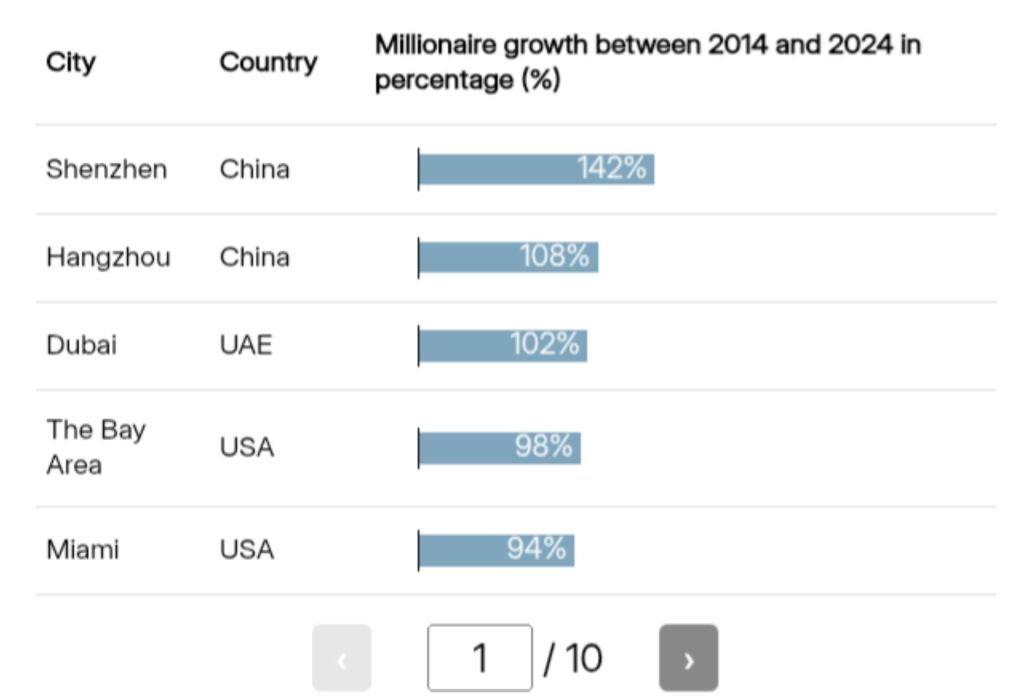
Once you add in low interest mortgages and flexible financing, it’s clear to see why we are in the midst of a property boom. More millionaires and high net worths are moving here, more branded residences are being built, and Dubai regularly ranks as a great place to live.

Property cycle

Property markets tend to move in cycles, and booms can’t last forever.  So where are we in this current cycle? “We are definitely at the top, but what happens next will determine where we end up,” says Mario Volpi, head of brokerage at Novvi Properties.


“By this I mean, if we were to continue with the same population growth, we won’t see a stabilisation much before 2027 but if the numbers actually grow more,  this bull run could go on for much longer.”


Richard Waind, CEO of Cencorp which owns Betterhomes, a full-service real estate brokerage, explains why a slowdown in prices might happen. “The inflow of people to Dubai will remain strong in the coming years, but increased supply may have an impact on prices in the short term, especially in the apartments sector. But villa and townhouses may remain undersupplied, given market demand.”

He points out that there are currently more than 1,700 projects under construction from over 200 developers.


Gabriel Tamman, a luxury property specialist with Tribeca Real Estate, is more bullish about the longevity of the property boom. “We are nowhere near the top. Unlike mature markets, Dubai is still in a high-growth phase. The UAE is a young country with the vision, resources, and policies to attract and retain talent and wealth,” he says.


Regardless of where you think we are in the cycle, Raji Kaippallil, founder of financewithRaji, makes a good point. “Those who view real estate as a long-term investment have little to worry about.”

History repeating?

When it comes to investing, a well-known disclaimer is that past performance is no guarantee of future performance. When it comes to property, can we learn from past booms and cycles?


“Each cycle is different but given what is mainly driving the demand at the moment, this gives this growth a more robust feel,” says Volpi.


Waind agrees that this current property cycle is very different from others. “Past markets in Dubai were far more speculative and unregulated. Today’s market is underpinned by strong economic fundamentals and population growth, and is well regulated and well capitalised.


“Ever increasing homeownership is creating a far more sustainable and ‘sticky’ market, a more mature market, which will protect buyers from any future market corrections”.

But while the outlook is healthy and optimistic, experts always have to be on their guard for a slowdown caused naturally or from unexpected events. “Dubai’s real estate market has experienced extreme growth over the past two years, raising concerns about potential overheating,” says Nataliya Khudykovska, a luxury real estate adviser.


But she then quickly lists all the factors that suggest that the market still has room for further expansion. These include strong demand from global investors, the growing number of wealthy residents (millionaires and High Net Worths), and stricter market regulations.


She pointed to current market dynamics to support her argument. “Project launches are proving very successful and many sell out on the day of launch itself, so far demand is keeping up with the supply.”


The mood is definitely upbeat, the fundamentals look good and no-one even mentioned the words ‘bubble’ or ‘bust’. To put current price levels in context, Waind explains that “Prices have increased roughly 20 per cent a year since 2020, but these prices have recovered from an extremely low level.”

“Today prices offer great value in comparison to other world markets, and according to the UBS Property Bubble index Dubai continues to offer ‘fair value’.


Khudykovska also highlights that prices haven’t yet reached historical peaks. “Despite their rapid growth, prices in some segments remain lower than during the 2014 boom.”

Buyer habits

So buyer demand is clearly strong, but what are they looking for in a property? Khudykovska observes that preferences in Dubai have shifted significantly over the past few years, reflecting changes in lifestyle, work habits and global investment trends.


“These include increased demand for larger spaces. Buyers are prioritising villas, townhouses, and spacious apartments over compact units. Communities like Dubai Hills Estate, District One, and Tilal Al Ghaf are seeing record demand for larger homes with private gardens and pools.”


Dubai has always had a reputation for luxury properties, and this is being cemented with the rise of high-end branded residences, exclusive penthouses and waterfront estates being built, to cater to the inflow of millionaires and HNWs.

“Dubai is becoming a top choice for wealth preservation,” says Khudykovska, founder of NKD real estate. “The luxury segment faces a significant lack of available properties, pushing prices even higher. While the situation in the mainstream housing market is slightly better, demand continues to rise.”

Flip and fix

One of the challenges with the property market has always been speculative buyers, who flip properties looking for a quick profit. We asked experts if this is still a trend among today’s buyers.


They told us that some investors continue to flip off-plan properties before handover, taking advantage of Dubai’s fast-rising prices and strong demand. High-end projects in Palm Jumeirah, Dubai Marina, and branded residences often sell out quickly, allowing early buyers to resell at a premium before completion.


But developers are increasingly introducing anti-flipping clauses, such as mandatory holding periods to prevent excessive speculation. Tamman adds that while off-plan flipping is still popular, fix-and-flip strategies are thriving.

Hot spots

And when it comes to new developments, there are plenty to choose from, catering to all types of buyers. Property experts listed a number of exciting projects in the pipeline, including Palm Jebel Ali, Downtown and Emaar Beachfront which all look highly promising.


Dubai is still developing its desert areas towards Dubai South (near Expo City and the new Al Maktoum International Airport), where new residential projects and business centres are emerging. While new island living, such as Dubai Islands (formerly Deira Islands), will feature new beaches, hotels, and luxury villas. Looking further ahead, The World Islands will be a collection of private islands for the ultra wealthy.

If you are searching for residential properties to buy either offplan or ready Properties in the UAE, we will give you options to suit your budget.

Be sure to join our investor contact list to be notified about prelaunch and first launch deals to ensure you get first advantage buying.

Contact Us for more information , to book a unit or consultation session on WhatsApp +971 55 134 8912

Philly2dubairealtor,……………….

Re-Blogged via Khaleej Times

Citi Developers launches new project in Dubai Islands

Agua expected to push boundaries in Dubai’s luxury real estate

Citi Developers, a major player in boutique, high-end real estate, has launched AGUA, a new project at Dubai Islands. Designed as more than just a development, AGUA is a multi-sensory experience, where architecture, innovation, and nature seamlessly blend to create an unparalleled lifestyle.


Following the success of Allura, one of Dubai’s most exclusive developments, Citi Developers continues to push boundaries with AGUA, offering a new benchmark in sophisticated, intelligent living. Every detail of AGUA is meticulously designed to immerse residents in fluid luxury, from its sculptural architectural elements to its AI-powered smart living solutions.

At the heart of AGUA lies a philosophy of balance, innovation, and craftsmanship. The development integrates state-of-the-art materials, seamless smart automation, and bespoke interior artistry, ensuring that every home is an extension of the resident’s lifestyle and vision.

Key highlights of AGUA include:

A sanctuary in the sky, Cloud 9 features floating cabanas, an infinity beach pool, and a sunken pool bar, creating a seamless blend between the ocean and skyline.Designed to nurture the mind, body, and soul, The Base offers a Roman bath spa, outdoor yoga spaces, a private cinema, and world-class fitness facilities, making well-being an integral part of daily life. The Orobico marble reception desk and crystal chandeliers create a statement of elegance, welcoming residents into a world of timeless sophistication from the moment they arrive.


Every residence is equipped with Personal Assistant Robot AI-powered smart automation, allowing for seamless home management, concierge services, and personalized convenience, setting a new standard in next-generation living.

“I don’t just build homes; I craft experiences that shape the way people live. AGUA is our vision of what modern living should be—intelligent, seamless, and connected to nature in every way,” said the CEO of Citi Developers.

With a legacy of designing iconic, high-end developments like Allura, Citi Developers continues to push boundaries, ensuring that every project is a masterpiece of artistry and innovation.

If you are searching for residential properties to buy either offplan or ready Properties in the UAE, we will give you options to suit your budget.

Be sure to join our investor contact list to be notified about prelaunch and first launch deals to ensure you get first advantage buying.

Contact Us for more information , to book a unit or consultation session on WhatsApp +971 55 134 8912

Philly2dubairealtor,………………….

Re-Blogged via Khaleej Times